 gaetano
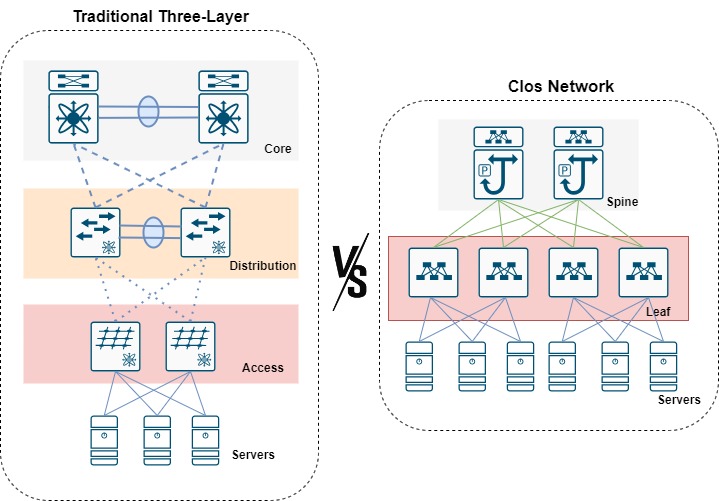 Traditional Three-Layer vs. Clos Network
Modern workloads and application deployment are expected to happen in minutes or seconds. Speed of deployment and the ability to scale up as workload requirements expand are critical. For this reason, traditional designs are no longer sufficient. This is the case regardless of whether data centers exist in combination with a private, public, or hybrid cloud.
Traditional Three-Layer Network Challenges
Traditional Three-Layer Network is based on the STP (spanning tree protocol) and is divided into three layers. Each layer has specific functions and characteristics:
- Access Layer: connects directly to end devices such as servers.
- Distribution Layer: an intermediary layer between the access and core layers, aggregating the data from access layer switches.
- Core Layer: provides fast and efficient data transport across the network.
Traditional networks face various issues that make their adoption difficult for large data centers mainly due to STP limitations:
- Aggregation and Core Layer Bottlenecks:
- As the number of endpoints increases, the distribution and core layer switches must handle a growing number of MAC addresses and IP routes
- Core layer manages all traffic between different aggregation layer switches, which can lead to congestion and increased latency.
- Complexity to Manage as the Network Grows:
- The complexity increases with the number of VLANs, which need to be configured, monitored, and troubleshot among the three layers
- Centralized all layer 3 gateways at the core/distribution layer with redundancy mechanisms (e.g., HSRP, VRRP) to ensure high availability can become increasingly difficult.
- Inefficient Resource Utilization: traffic between servers in different VLANs must traverse multiple layers (access, aggregation, core), leading to suboptimal paths and increased latency.
- Convergence Issues: High traffic convergence times due to STP tree recalculations.
- Unused Links: links in blocking state due to STP, leading to inefficient resource utilization.
- Suboptimal Forwarding: Traffic is forwarded along a single path, ignoring shorter paths.
- Lack of ECMP Routing: Only one path is active between source and destination switches.
- Traffic Storm Issues: Potential for endless traffic loops without a TTL field.
- Lack of Dual-Homing Support: Devices cannot attach to more than one switch without forming loops.
- Network Scale: The 4096 (4K) unique VLANs are insufficient for modern data centers.
- Configuring, monitoring, and troubleshooting VLANs across a growing network can be challenging
Transition to CLOS (Leaf-Spine) Architecture
The leaf-spine architecture addresses these issues by flattening the network design, where all leaf switches (access layer) connect directly to all spine switches (core layer).
All links between spine and leaf switches operate at Layer 3. These links carry IP packets and use routing protocols like OSPF in the underlay to exchange routing information avoiding the need for STP.
This modern design decentralizes Layer 3 routing, moving default gateways to the leaf layer. The leaf switches directly connect to endpoints and communicate with spine switches, which interconnect all leaf switches, forming a high-speed, non-blocking network fabric.
VXLAN is currently the most popular overlay encapsulation in use within a leaf-spine architecture for dataplane traffic transport. VXLAN is a MAC-in-IP/UDP encapsulation that supports up to 16 million virtual networks overcoming the limitations of the 4K VLAN namespace.
Key Advantages of the Leaf-Spine Design Include:
- Scalability: It is highly scalable and easily expandable by adding more leaf or spine switches, unlike the traditional model constrained by core layer bottlenecks.
- Redundancy and Fault Tolerance: Multiple paths between any leaf and spine switch inherently provide redundancy, reducing single points of failure.
- Latency: The design offers predictable, low-latency performance due to equal-distance connectivity.
- Simplicity and Management: It simplifies network management with its streamlined structure, which is especially beneficial for large-scale deployments.
- Efficient resource utilization:
- Eliminating the need for complex Layer 2 redundancy protocols and reducing the reliance on centralized Layer 3 gateways.
- The equal-distance connectivity between leaf and spine switches ensures predictable performance and efficient utilization of network resources, as traffic takes the shortest path through the network.
Comparison
| Traditional Three-Layer Network | CLOS Leaf-Spine Architecture | |
|---|---|---|
| Scalability | Limited scalability due to core layer bottlenecks. | Highly scalable, easily expandable horizontally. |
| Redundancy and Fault Tolerance | Redundancy is achieved through complex configurations, potentially leading to single points of failure. | Redundancy is inherent due to multiple paths between any leaf and spine switch. |
| Latency | Latency can be higher due to multiple layers of routing/switching. | Low and consistent latency due to equal-distance connectivity. |
| Complexity | Complex to manage, especially in large networks. | Simpler and more streamlined, especially at scale. |
| Cost | Initial costs might be lower for smaller networks. | Higher initial investment but offers better long-term scalability and performance. |