 gaetano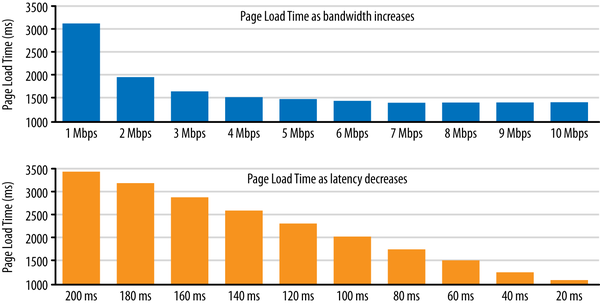
Problem Statement
Page Load Time (PLT) is a critical metric for user experience and conversion rates. However, PLT depends on three factors:
- Bandwidth — Available bitrate (Mbps)
- Latency — Round-trip time (RTT, milliseconds)
- Protocol Efficiency — How well the protocol utilizes available bandwidth
While bandwidth and latency are properties of the network path, the protocol layer presents a significant opportunity for optimization. Traditional HTTP/1.1 has inherent inefficiencies (connection establishment overhead, head-of-line blocking) that impact PLT, especially on high-latency or lossy networks.
HTTP Protocol Evolution
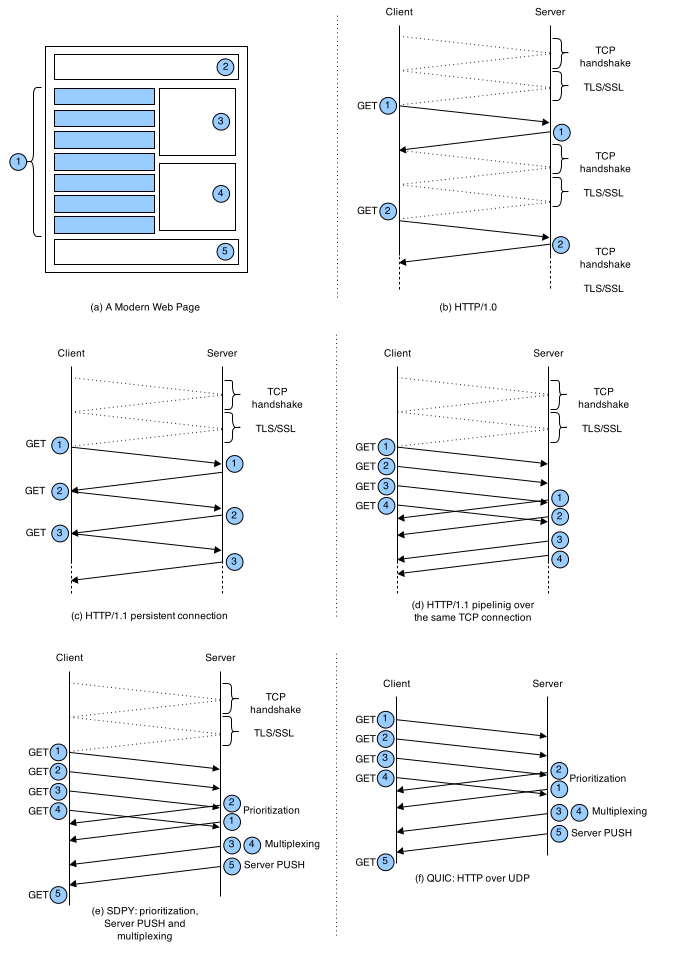
- HTTP/1.0 — Single request per connection (connection-close model)
- HTTP/1.1 — Persistent connections, pipelining (limited adoption due to head-of-line blocking)
- HTTP/2.0 — Multiplexing over single connection, header compression, server push
- HTTP/3.0 — Built on QUIC (UDP-based), 0-RTT resumption, improved loss recovery
Experimental Setup
Testbed Configuration:
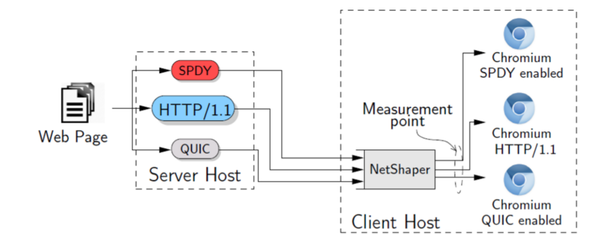
- HTTP server: Apache/2.4.10 with TLS 1.2
- SPDY server: nghttp2 with TLS 1.2 (nghttp2 supports SPDY 4, which is Google's implementation of HTTP/2.0)
- QUIC server: version 24 server in the Chromium code base with QUIC-Crypto
- Netshaper: sets channel capacity and propagation delays
Real experiments were run using the open-source browser Chromium. An example of testbed usage is available on GitHub.
Testbed settings: Buffer sizes: Q = BDP • Base RTT: 50ms • Bottleneck Capacity: 3 Mbps • Loss free channel. The web page used to compare HTTP/1.1, HTTP/2.0 (SPDY), and QUIC contains only JPEG images, without any JavaScript code or CSS file.
Protocol Comparison Charts
Experiment with HTTP/1.1 — Page Load time: 2.03s
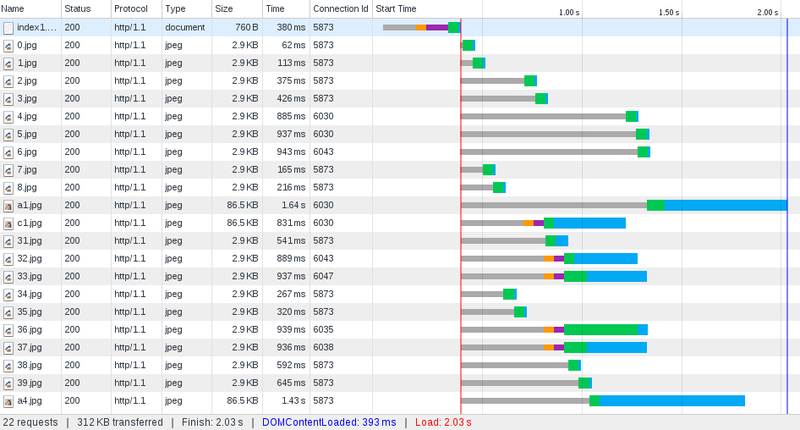
- Six TCP connections are opened (each requires a TCP and TLS handshake)
- One resource at a time is transferred over each connection
Experiment with HTTP/2.0 — Page Load time: 1.45s
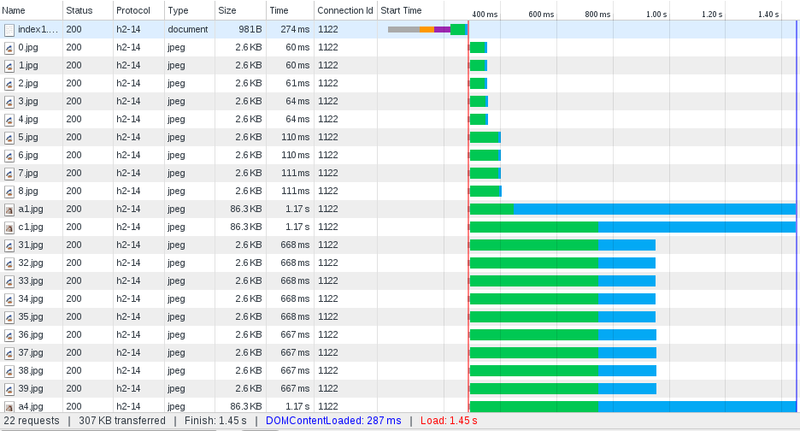
- One TCP connection is opened. All requests are sent when the DOM is loaded
- Resources are multiplexed and sent simultaneously over a single TCP connection
Experiment with QUIC — Page Load time: 1.14s
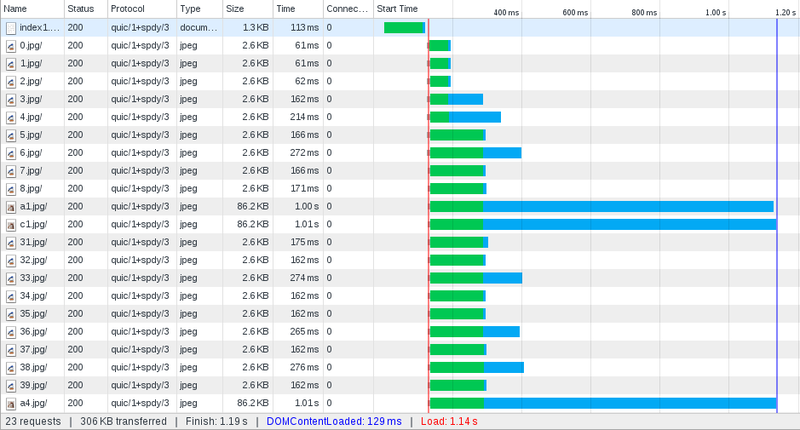
- One UDP connection
- No handshake required
Experimental Results
| Protocol | Page Load Time | Connections |
|---|---|---|
| HTTP/1.1 | 2.03 sec | 6 TCP (one per resource) |
| HTTP/2.0 (SPDY) | 1.45 sec | 1 TCP (multiplexed) |
| QUIC | 1.14 sec | 1 UDP, no handshake |
QUIC reduces the overall page retrieval time with respect to HTTP in the case of a channel without induced random losses, and outperforms HTTP/2.0 in the case of a lossy channel.
Detailed Analysis
Gaetano Carlucci, Luca De Cicco, Saverio Mascolo — HTTP over UDP: an experimental investigation of QUIC — Proc. of 30th ACM/SIGAPP SAC 2015, Salamanca, Spain, April 2015
Key Performance Insights
- Connection Overhead Matters — HTTP/1.1's 6 parallel connections add significant latency on high-RTT networks (satellite, intercontinental)
- Multiplexing Benefits — Consolidating to single connection saves setup overhead but doesn't solve head-of-line blocking at transport layer
- Loss Recovery — QUIC's stream-level recovery eliminates transport-layer head-of-line blocking, critical on lossy networks (mobile, WiFi)
- Handshake Amortization — QUIC's 0-RTT resumption provides the largest benefit for repeat visits (potential 1-RTT saving)
Reference
Detailed experimental results published in:
G. Carlucci, L. De Cicco, S. Mascolo — HTTP over UDP: an experimental investigation of QUIC — ACM SIGAPP SAC 2015 (also available as PDF)
Testbed and Reproduction
To reproduce these experiments, use the WAN emulation and NetEM configuration tools provided here: